
Can a 42 Ton Forklift Be Customized?
A 42 ton forklift is rarely selected for simple pallet handling. At this capacity, the truck is more likely to work with heavy machinery, steel products, project cargo, large industrial components or other loads that do not fit a standard forklift configuration.
For that reason, customization is common on large forklifts. But customization does not mean that every component can be changed independently.
For a heavy-duty forklift, the load, load center, lifting height, attachment and working environment need to be considered together before the final configuration is confirmed.
What Can Be Customized on a 42 Ton Forklift?
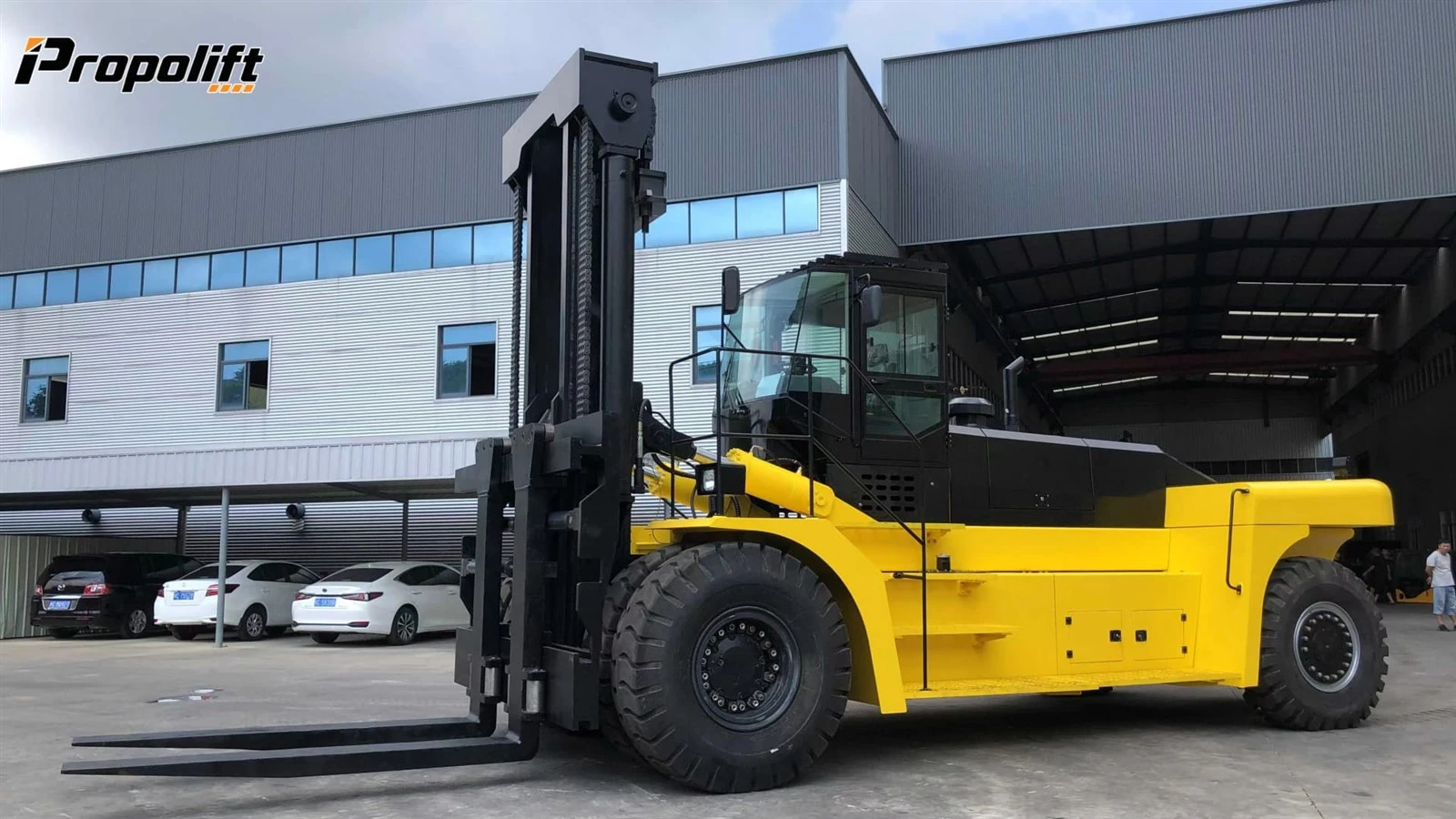
Several parts of a 42 Ton Forklift can normally be configured according to the application.
The most common areas include:
- fork dimensions
- mast and lifting height
- fork positioner or side shift
- special attachments
- engine and emission configuration
- transmission options
- tire specification
- additional hydraulic circuits for attachments
Some changes are relatively simple. Others affect the load center, stability or residual capacity of the truck and therefore require additional engineering checks.
This distinction is important on a 42 ton forklift because even a small change in load position can have a much greater effect than it would on a small warehouse forklift.
Load Center Comes Before Forklift Capacity
One of the first questions we ask on a heavy-duty forklift project is not only:
How heavy is the load?
We also need to know:
Where is the load center?
A 42 ton rated capacity does not mean the forklift can lift 42 tons at any distance from the fork face.
Long machinery, steel structures, large molds or oversized cargo can move the load center forward. When this happens, the effective lifting capacity changes.
The same applies when a heavy attachment is installed.
This is why load dimensions are just as important as load weight when we review a customized forklift request.
Fork Length and Size Need to Match the Load
Forks are one of the most frequently customized parts on heavy-duty forklifts.
Length, width and thickness may all need to change depending on the cargo.
For example, a heavy machine with a wide support base may require longer forks than a compact steel block of the same weight.
However, longer forks should not simply be treated as an upgrade.
If the load sits farther forward, the load center increases. The forklift capacity must then be checked again under the actual loading condition.
For a large forklift, we normally confirm:
- load weight
- load dimensions
- fork entry position
- required fork length
- load center
- lifting height
before finalizing the fork specification.
Attachments Change More Than the Handling Method
Some applications cannot be handled with standard forks.
Depending on the load, a heavy-duty forklift may require a fork positioner, side shift, lifting jib, hook attachment or another specially designed handling device.
The attachment itself adds weight and may move the load farther away from the forklift.
This means attachment selection is not only about whether the attachment can hold the cargo. It also affects the capacity calculation of the complete truck.
For this reason, we prefer to confirm the attachment at the beginning of the project rather than add it after the forklift specification has already been fixed.
Engine and Emission Configuration
Engine selection on a 42 ton forklift is usually related to duty cycle, destination market and local emission requirements.
A truck working in a port yard may have a different operating pattern from one moving heavy machinery inside an industrial plant.
The destination market also matters because emission requirements vary between countries and regions.
Engine options therefore need to be confirmed before production.
One point is worth making clear: installing a higher-output engine does not by itself increase the rated lifting capacity of the forklift.
Capacity depends on the complete truck design, including the chassis, mast, counterweight, axles, tires, hydraulic system and load center.
What We Need Before Production
For a customized 42 ton forklift, the most useful information is usually straightforward.
Load Weight
Provide the maximum working load, not only the average load.
Load Dimensions
Length, width and height help determine the actual load center and required fork dimensions.
Load Center
This is one of the key figures for capacity calculation.
Required Lifting Height
The lifting height affects mast selection and residual capacity.
Working Environment
Indoor or outdoor operation, ground condition, available turning space and travel distance all matter.
Destination Market
Emission standards, certification requirements and local operating conditions should be confirmed before production.
The earlier these details are provided, the easier it is to avoid configuration changes later.
Customization Can Affect Lead Time
A standard forklift specification can normally move into production more quickly than a heavily customized machine.
Changes involving forks, mast structure, hydraulic circuits or attachments may require additional design confirmation, component sourcing and testing.
For this reason, we normally try to finalize the main technical requirements before assembly begins.
Changing fork dimensions before production is one thing. Changing the load center or attachment after the machine has already entered assembly can affect several other parts of the truck.
A clear technical specification at the beginning usually saves more time than trying to shorten the production schedule later.
When Is a Standard 42 Ton Forklift Enough?
Not every 42 ton forklift needs extensive customization.
If the load dimensions, load center, lifting height and working environment already match the standard configuration, changing the truck simply for the sake of customization adds unnecessary cost and complexity.
For some heavy equipment handling applications, a standard heavy-duty forklift with the correct fork dimensions may already be sufficient.
This is why we do not start every project by asking what the customer wants to modify.
We first look at the load and working condition.
If the standard configuration works, there is no reason to redesign it.
When Does a Customized Configuration Make More Sense?
Customization becomes more useful when the application falls outside standard forklift conditions.
Typical examples include:
oversized industrial machinery
unusual load centers
steel and metal products
project cargo
port and terminal handling
special lifting or hook applications
loads requiring non-standard fork dimensions
In some of our heavy-duty forklift projects, customers use large-capacity forklifts at ports and terminals for loaded container handling, while manufacturing plants use them for moving heavy machinery and equipment.
These applications are very different, even when the load weight is similar.
That is why a heavy-duty forklift should be selected around the actual job rather than capacity alone.
If the required capacity is above the 42 ton range, a 50 Ton Forklift may also be worth evaluating, depending on load center and working conditions.
Customization Should Start With the Load
A 42 ton forklift can be customized, but the useful question is not simply:
"What options can be added?"
The better starting point is:
What does the forklift need to lift, where will it work, and how will the load be positioned?
Once the load weight, dimensions, load center, lifting height and operating environment are clear, the manufacturer can determine which parts should remain standard and which parts genuinely need to be changed.
For a heavy-duty forklift, that approach is usually more reliable than selecting a long list of options first and trying to make the machine fit the job afterward.
References
U.S. Occupational Safety and Health Administration (OSHA) - 29 CFR 1910.178, Powered Industrial Trucks. Requirements concerning truck capacity, manufacturer approval for modifications, attachments and safe operation.
OSHA - Powered Industrial Trucks: Load Handling and Loading. Guidance concerning rated capacity, load positioning and the effect of long or high loads on forklift operation.
OSHA - Powered Industrial Trucks: Overhead Guards. Guidance on operator protection and overhead guard requirements for powered industrial trucks.
ISO 3691-1 - Industrial Trucks: Safety Requirements and Verification - Part 1. Safety requirements for self-propelled industrial trucks, including counterbalanced lift trucks.
Propolift Machinery - Heavy-Duty Forklift Technical Specifications and Application Data. Manufacturer reference for heavy-duty forklift configuration, load center, fork dimensions and application matching.