

Items: CPCD30
Load Capacity: 3,000 kg(~6600lb)
Load Center: 500mm
Engine: Xinchai/Mitsubishi/Isuzu/Kubota
Lead Time: 35-45 days

Diesel Forklift
China Diesel Forklift Manufacturer & OEM Factory for 2.5–6T Industrial Handling
Propolift supplies 2.5–6T diesel forklifts for factories, warehouses, construction sites and outdoor yards. The current range includes CPCD25, CPCD30, CPCD40, CPCD45 and CPCD60 models, with 500 mm load center ratings and multiple engine options including Xinchai, Mitsubishi, Isuzu, Yanmar and Kubota.
For OEM projects, forklift configuration can be reviewed according to load center, lifting height, fork length, tyre type, operating environment and destination-market requirements. See our OEM & ODM Forklift Manufacturing page for custom specifications and production support.
Request Factory Direct Pricing & Load Calculation
Explore Our Diesel Forklift Fleet & Models
Compare rated capacity, load center, lifting height and available configurations across the current diesel forklift range below.
-
![3 Ton Diesel Forklift]()
-
![4.5 Ton Forklift]() 4.5 Ton ForkliftItems: CPCD45read more
Load Capacity: 4,500 kg(~9900lb)
Load Center: 500mm
Engine: Xinchai/Yanmar/Isuzu/Kubota
Lead Time: 35-45 days -
![2.5 Ton Forklift]() 2.5 Ton ForkliftItems: CPCD25read more
Load Capacity: 2,500 kg(~5500lb)
Load Center: 500mm
Engine: Xinchai/Mitsubishi/Isuzu/Kubota
Lead Time: 35-45 days -
![6 Ton Forklift]() 6 Ton ForkliftItems: CPCD60read more
Load Capacity: 6,000 kg(~13200lb)
Load Center: 500mm
Engine: Xichai/Mitsubishi/Isuzu/Kubota
Lead Time: 35-45 days -
![4 Ton Diesel Forklift]() 4 Ton Diesel ForkliftItems: CPCD40read more
Load Capacity: 4,000 kg(~8800lb)
Load Center: 500mm
Engine: Xichai/Mitsubishi/Isuzu/Kubota
Lead Time: 35-45 days -
![2.5 Tonne Forklift]() 2.5 Tonne ForkliftItems: CPCD25read more
Load Capacity: 2,500 kg(~5500lb)
Load Center: 500mm
Engine: Xinchai/Mitsubishi/Isuzu/Kubota
Lead Time: 35-45 days


Chassis Structure, Powertrain & Mast Engineering
A diesel counterbalance forklift in the 2.5–6 tonne class needs to be evaluated as a complete load-bearing system rather than by engine output alone. The main structural path runs through the counterweight frame, axle mounts, mast rails, carriage, forks and wheelbase. For project orders with higher structural requirements, the material grade and welding specification should be stated in the approved technical document rather than assumed from a standard catalogue description.
The current Propolift diesel models use a conventional counterbalanced layout with 500 mm load center ratings and a standard 3,000 mm lifting height across the listed 2.5–6 tonne range. Published model data shows 2.5T, 3T, 4T and 4.5T machines with approximately 18–21% gradeability depending on configuration, while the CPCD60 specification sheet does not publish a gradeability figure. Final specifications should therefore be confirmed against the actual build sheet before order confirmation.
For a forklift buyer, the term Rated Capacity at Load Center is more useful than tonnage alone. A 4,000 kg forklift rated at 500 mm load center is not automatically a 4,000 kg machine at 700 or 1,000 mm. Longer forks, oversized pallets, attachments and forward-positioned cargo increase the overturning moment and may require a residual capacity check.
Mast selection follows the same principle. A standard duplex mast may be suitable for open-yard work, while a triplex configuration can be specified where higher stacking or restricted overhead clearance is required. Where full free lift is needed, the mast should be selected around the actual working height rather than maximum lift height alone. Fork length, carriage width and attachment weight must also be included in the load calculation.
Technical Specifications
|
Model |
Rated Capacity |
Rated Load Center |
Standard Lift Height |
Engine / Powertrain |
Published Gradeability |
|
CPCD25 |
2,500 kg |
500 mm |
3,000 mm |
Xinchai / Mitsubishi / Isuzu / Kubota |
20–21% |
|
CPCD30 |
3,000 kg |
500 mm |
3,000 mm |
Xinchai / Mitsubishi / Isuzu / Kubota |
20–21% |
|
CPCD40 |
4,000 kg |
500 mm |
3,000 mm |
Xichai / Mitsubishi / Isuzu / Kubota |
18–19% |
|
CPCD45 |
4,500 kg |
500 mm |
3,000 mm |
Xinchai / Yanmar / Isuzu / Kubota |
18–19% |
|
CPCD60 |
6,000 kg |
500 mm |
3,000 mm |
Xichai / Mitsubishi / Isuzu / Kubota |
Confirm by build |
*Technical data may change according to the confirmed machine configuration and production requirements.
The engine should also be selected around the destination market and duty cycle. For export projects, buyers may specify a familiar engine platform according to local service coverage, spare-parts access and emissions requirements. The current Propolift product range publishes Xinchai, Mitsubishi, Isuzu, Yanmar and Kubota options across different diesel models.
Where the final specification requires a defined axle, transmission or mast component brand, that information should be listed in the purchase specification and quotation rather than inferred from the generic category page.
Hydraulic Circuitry, Operational Safety & Rigorous Working Conditions
The hydraulic system should be matched to the lifting load, mast height and required cycle frequency. The main hydraulic circuit controls lifting and tilt functions, while auxiliary hydraulic lines can be prepared for equipment such as side shifters, fork positioners or other attachments. The correct specification should include pump flow, relief pressure, cylinder sizing and auxiliary circuit requirements where applicable.
For high-frequency pallet work, controlled hydraulic response matters during the final approach to the rack or truck bed. An inching control system can reduce drivetrain shock and allow the operator to creep into position while maintaining hydraulic lifting control. Where a model uses power-shift or hydraulic transmission architecture, the exact transmission arrangement should be confirmed on the final machine quotation.
Load-holding and lowering protection also deserve attention. A properly specified mast circuit should prevent uncontrolled descent and maintain controlled lowering under normal operating conditions. Where additional safety valves are required by the application or destination-market specification, they should be included in the engineering approval before production.
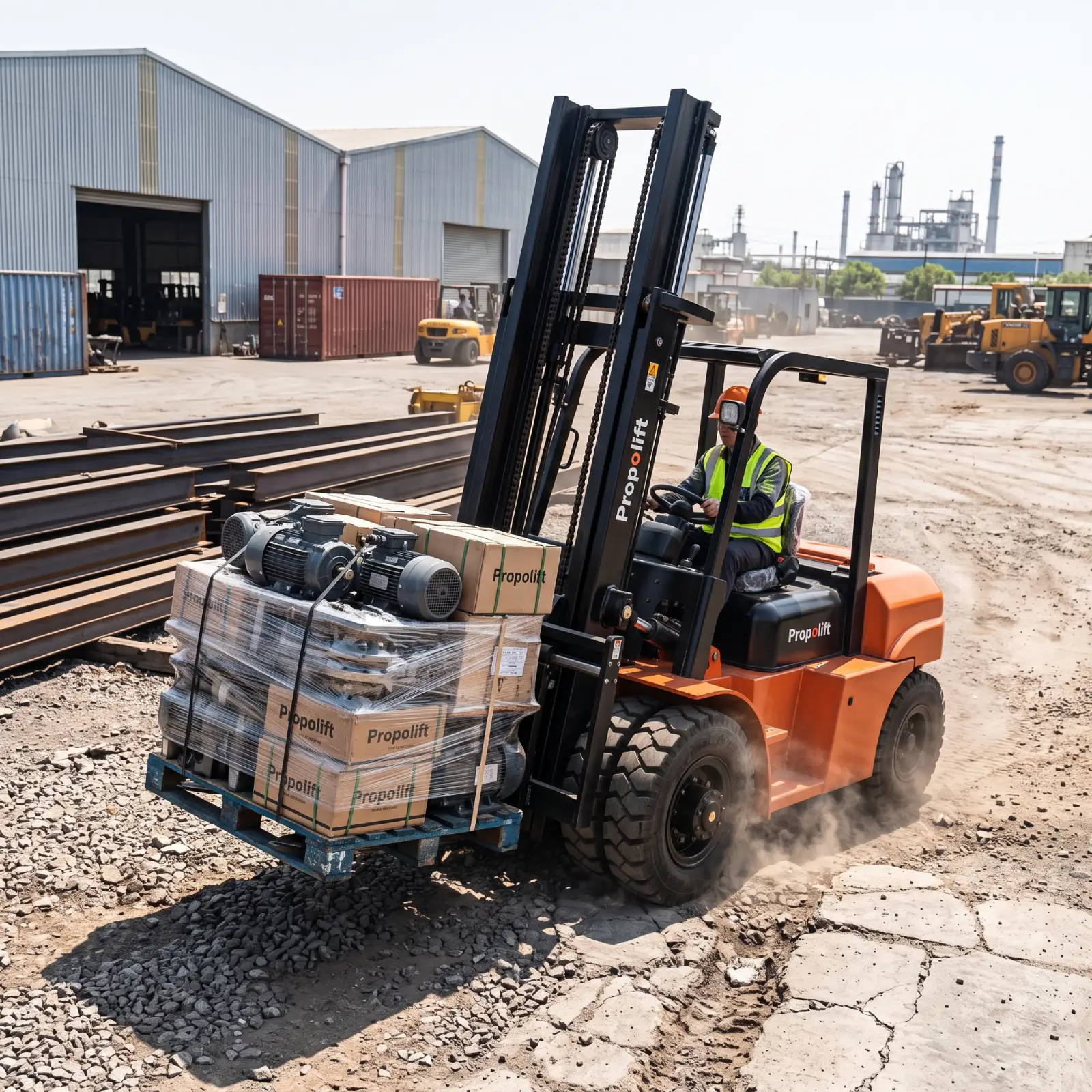
Tyre selection changes how the machine behaves on the ground. Pneumatic tyres are commonly used where the forklift travels across outdoor concrete, gravel, asphalt or uneven yard surfaces. Solid tyres may be selected where puncture resistance and stable operation on flatter industrial floors are more important. The tyre specification should match both the axle load and the working surface.
Heat management is another practical concern for long-hour diesel operation. For a site with high ambient temperatures or long continuous travel cycles, the engineering review should cover radiator capacity, airflow, fan selection, hydraulic oil temperature, intake filtration and engine operating conditions. A stated ambient requirement such as 45–50°C should be treated as a design input and confirmed before production rather than assumed from the standard machine.
Stability should always be checked against the actual load condition. Load center, fork engagement, lifting height, turning direction, ground slope and off-center loading all affect the stability margin. For unusual loads, the correct procedure is to review the complete load geometry before selecting the forklift model.
Inquire for Custom Mast & Attachment Configurations
Quality Assurance, Load Verification & Factory Delivery at Propolift
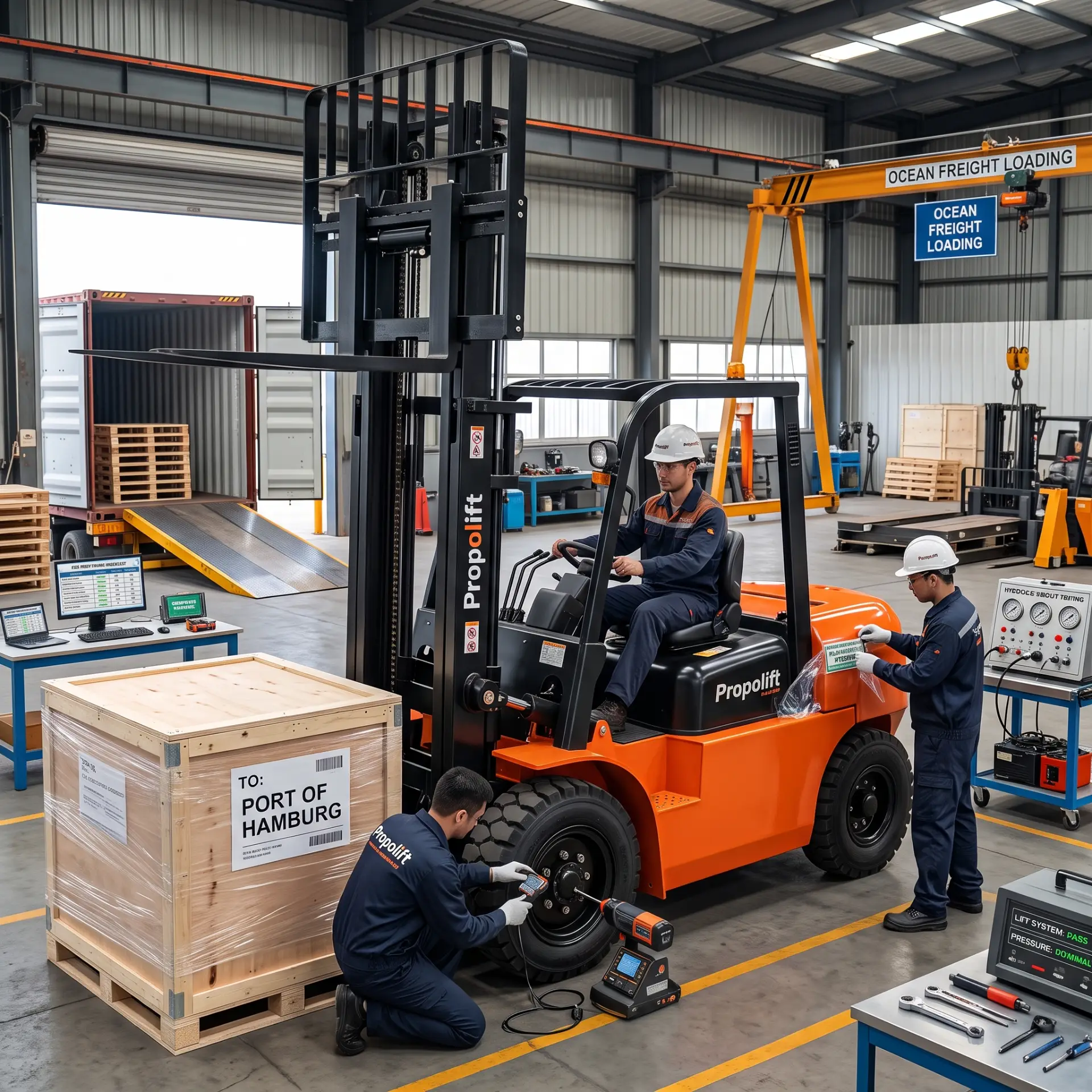
Propolift's published factory information describes a production process covering steel structure processing, assembly, hydraulic testing, final inspection and load testing. The factory also reports CNC cutting, bending equipment, forklift assembly lines, hydraulic test benches and full-machine inspection equipment.
For diesel forklift projects, the final inspection should cover the systems that directly affect safe operation: mast lifting and tilting, steering response, service braking, parking brake function, hydraulic operation, engine start-up, tyre condition, controls, instrumentation and visible leakage checks.
For a project requiring additional engineering verification, the inspection plan can specify the required test method before production. Depending on the machine and destination-market requirements, this may include rated-load stability verification, hydraulic pressure holding, mast alignment measurement, mast deflection inspection or additional proof-load testing. A 120% proof-load test or dynamic/static stability test should be listed as a defined customer requirement with an agreed test procedure rather than presented as a universal test on every diesel forklift.
For compliance documentation, the purchase specification should identify the applicable market and standard. ISO 3691-1 covers safety requirements and verification for self-propelled industrial trucks, including counterbalanced diesel trucks. US projects may specify ANSI/ITSDF B56.1 where applicable. European conformity documentation should be matched to the actual machine, destination market and regulatory regime.
As of 2026, EU buyers should also be aware that Regulation (EU) 2023/1230 on machinery becomes applicable on 20 January 2027, replacing the Machinery Directive framework. The conformity route and supporting documentation should therefore be confirmed according to the placing-on-the-market date.
For export delivery, the machine can be prepared according to the shipping arrangement and destination. The current factory information states that container loading, flat-rack shipping and other suitable transport arrangements may be used depending on machine dimensions and weight. Packaging should secure the mast, forks, overhead guard and other exposed components against movement during sea transport.
Products Description
Q: How should I select a diesel forklift when the load is close to the rated capacity?
A: Start with load weight, but also provide cargo dimensions, load center and required lift height. A 500 mm rated load center is a defined reference point, not a universal capacity at every distance. Long, deep or irregular loads may require a residual capacity check before the final model is confirmed.
Q: Can Propolift diesel forklifts be configured for stricter emissions markets?
A: Yes, depending on the model and destination. Current product information lists Xinchai, Mitsubishi, Isuzu, Yanmar and Kubota engine options, with selected configurations referenced for Euro Stage V or EPA Tier 4 Final markets. Confirm the exact engine, emissions configuration and supporting documents for the destination before production.
Q: Should I choose pneumatic or solid tyres for an outdoor diesel forklift?
A: Pneumatic tyres are generally more suitable for uneven concrete, gravel, asphalt and mixed outdoor surfaces because they provide additional shock absorption and traction. Solid tyres can be considered where puncture resistance matters more and the operating floor is relatively flat. Final tyre choice should also match axle load and duty cycle.
Q: What should be checked for diesel forklift operation in a very hot climate?
A: For high ambient temperatures, confirm the cooling package against the actual site condition and duty cycle. The review should cover radiator capacity, airflow, fan performance, hydraulic oil temperature, air filtration and engine operating conditions. If 45–50°C ambient temperature is expected, include that figure in the technical specification before production.
Factory Direct Inquiry for Diesel Forklift Projects
A diesel forklift quotation should start with the actual load rather than a tonnage number alone. Send the required capacity, cargo weight and dimensions, load center, lifting height, ground condition, operating hours, tyre preference, destination market and any OEM branding requirements.
Propolift's engineering team can review these inputs and prepare a machine configuration around the stated operating conditions, including the appropriate mast, engine, fork dimensions, tyres and auxiliary equipment. Submit the project details through Contact Us so the technical team can work from the same specification used for quotation and production planning.
Propolift Machinery Co., Ltd. is one of the most professional diesel forklift manufacturers and suppliers in China, featured by quality products and good price. Please rest assured to buy durable diesel forklift made in China here from our factory. Welcome to contact us for custom service and OEM service.