


Can a Forklift Lift More Than Its Rated Capacity?
This question usually comes up when a customer has a load that is only slightly heavier than the forklift they already have.
For example:
"We have a 10-ton forklift. Can it occasionally lift 11 tons?"
From a manufacturing and safety point of view, the answer is straightforward:
The forklift should not be operated beyond its approved rated capacity.
The fact that a truck may physically raise an overloaded object does not mean that it is safe or designed to handle that load.
OSHA regulations likewise state that only loads within the rated capacity of the truck should be handled.
Why a Forklift May Still Be Able to Raise an Overload
Hydraulic lifting power and forklift stability are not the same thing.
In some situations, the hydraulic system may generate enough force to begin lifting a load that exceeds the rated condition.
That can create a dangerous misunderstanding:
"It lifted it, so the forklift must be strong enough."
But rated capacity is not based only on whether the cylinders can raise the forks.
The manufacturer also considers:
- Truck stability
- Load center
- Mast structure
- Axles
- Forks
- Tires
- Braking
- Steering
- Complete vehicle design
A successful lift does not prove that all of these systems are operating within their intended limits.
Load Center Can Make an Apparently Safe Load Unsafe
Sometimes the cargo is actually lighter than the number shown on the forklift capacity plate, but it can still create an overload condition.
Consider a truck rated at:
10,000 kg at 600 mm load center
Now place a long 9,000 kg load on the forks with its center of gravity much farther forward.
Although 9 tons is below 10 tons, the increased load center can create a greater load moment than the rated condition.
OSHA specifically notes that capacity applies at the load center indicated on the truck's data plate and that oversized or improperly positioned loads can exceed the truck's effective capacity.
So the relevant question is not simply:
"Is the cargo lighter than the rated tonnage?"
It is:
"Is this load within the truck's rated capacity at its actual load center and working configuration?"
Attachments and Fork Configuration Can Change the Answer
A forklift may not retain the same usable capacity after its attachment or fork configuration is changed.
A side shifter, longer forks, a clamp, or other customized load-handling devices can add weight to the front of the truck or move the load farther forward. This can change the effective load center and reduce the capacity available under the actual working condition.
This is why the truck's capacity information should reflect the actual attachment and fork configuration.
OSHA's example data plate shows exactly this effect: the same forklift is rated at 5,000 lb with forks but 4,500 lb with a side shifter installed.
What If the Overload Is Only Occasional?
Occasional overload is still overload.
We would not recommend choosing a smaller forklift on the assumption that the heaviest cargo is handled "only once or twice a month."
If that load is part of the expected operation, it should be included when selecting the machine.
For example:
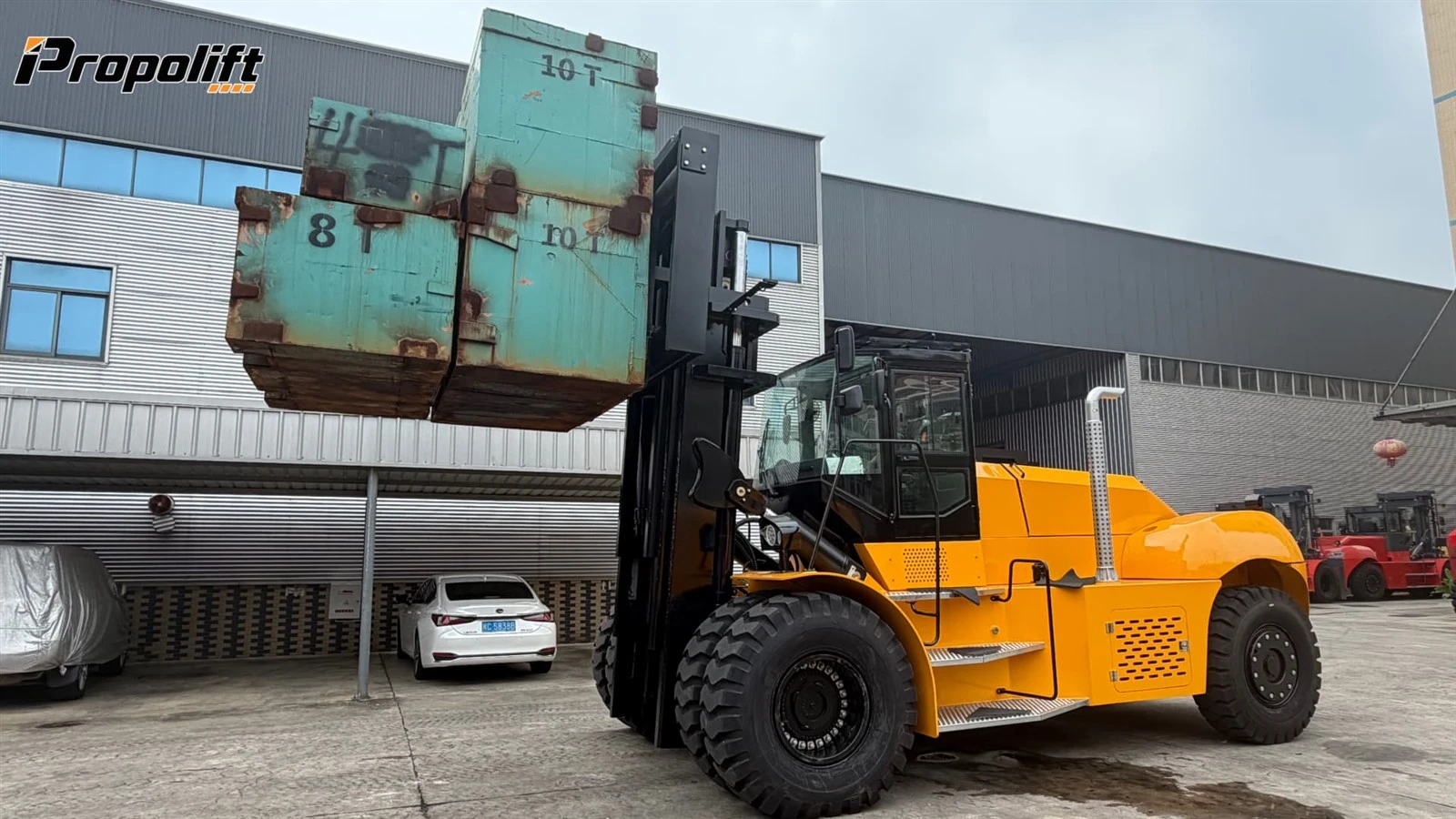
Normal loads: 8–9 tons
Maximum regular load: 11 tons
The forklift should be specified around the real maximum working condition, including its dimensions and load center.
Do Not Simply Add Counterweight
Another shortcut buyers sometimes ask about is adding more counterweight to an existing truck.
A forklift is a complete engineered system.
Increasing rear counterweight does not automatically upgrade:
- Mast capacity
- Fork strength
- Axles
- Tires
- Brakes
- Hydraulic system
- Chassis
Unauthorized modifications can also affect the manufacturer's approved capacity and safe operation.
Capacity changes should therefore come from the forklift manufacturer or an appropriately engineered configuration, not from adding weight to the rear of the truck.
What Should You Do If Your Load Has Increased?
If production requirements have changed and loads are now heavier than before, collect the following information:
- New maximum load weight
- Load dimensions
- Required lifting height
- Existing attachment
- Current forklift specification
The manufacturer can then determine whether the current truck is suitable for the new condition or whether a higher-capacity machine is needed.
Sometimes the issue is not simply upgrading from 10 tons to 12 tons.
The load center or attachment may be the real reason a different configuration is required.
Final Thoughts
A forklift should not be selected or operated on the assumption that there is "a little extra capacity available."
The rated capacity is there for a reason.
If the working load changes, the correct response is not to test how much more the forklift can lift. It is to check the new weight, load center and operating configuration and determine whether the truck is still suitable.
That is a much safer approach than discovering the limit during actual operation.
References
OSHA 29 CFR 1910.178 - Powered Industrial Trucks, Loading Requirements.
OSHA eTool - Forklift Nameplate and Capacity.
OSHA eTool - Load Composition and Load Center.