


How to Read Heavy Duty Forklift Transmission Specifications
When buyers compare diesel forklifts, the engine usually gets most of the attention.
The transmission line may simply say:
2 Forward / 2 Reverse
or:
2 Forward / 1 Reverse
On larger forklifts, buyers may also see three or more forward and reverse speeds.
What do these numbers actually mean, and does more gears mean a better forklift?
Not necessarily.
For a heavy duty forklift, the transmission should be matched to the engine, truck capacity and working cycle rather than judged by gear count alone.
What Does 2 Forward / 2 Reverse Mean?
The meaning is straightforward:
2 Forward / 2 Reverse = two forward speed ranges and two reverse speed ranges.
It does not mean the forklift has four driving directions.
The transmission provides different gear ratios for forward and reverse travel.
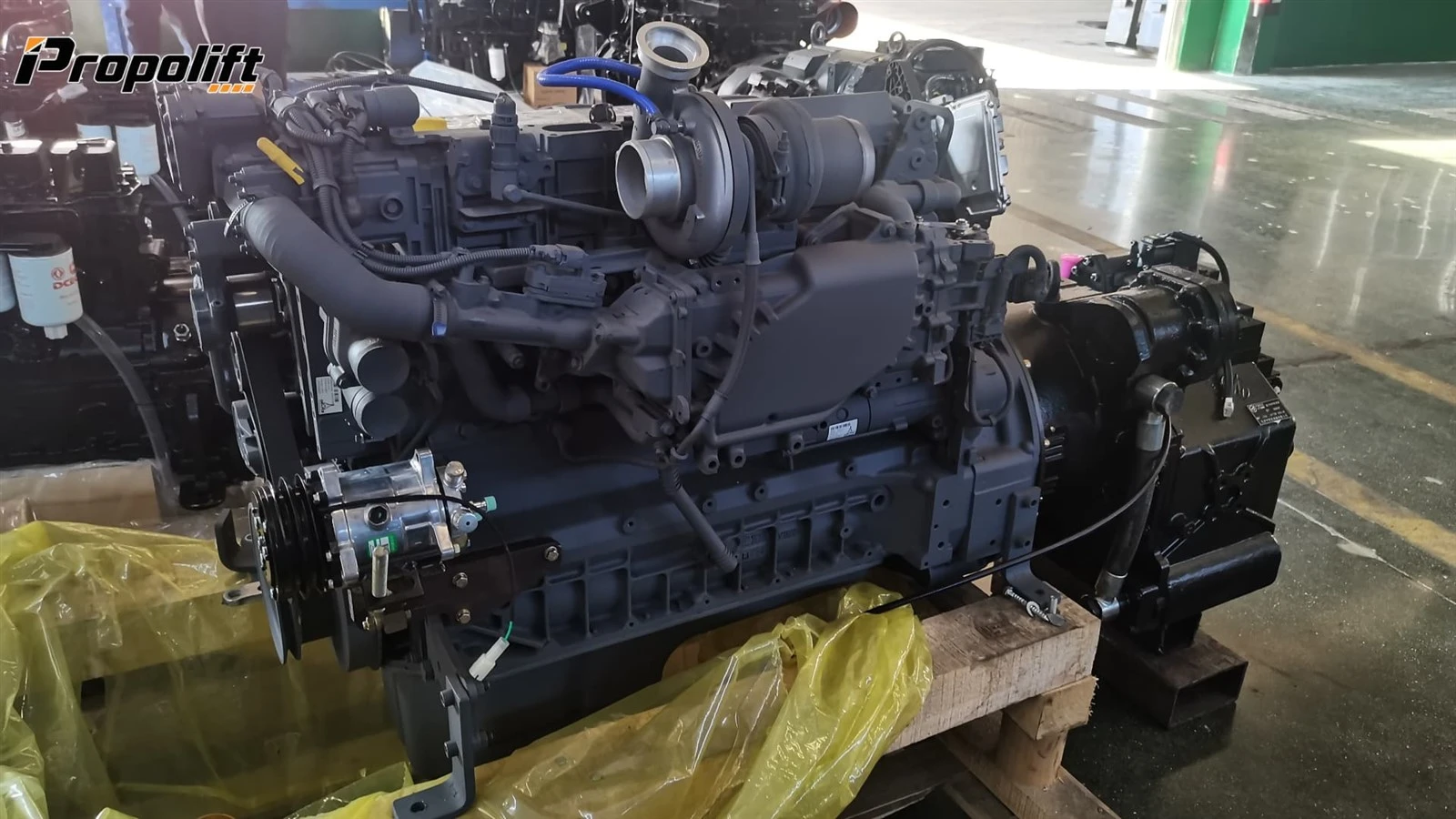
For example, our current 10-ton forklift specification uses a 2 forward / 2 reverse transmission.
This type of arrangement is also common elsewhere in the forklift industry. Toyota, for example, publishes powershift transmissions with 2 forward / 2 reverse speeds on its internal-combustion pneumatic forklift range.
Why Do Forklifts Need Different Gear Ratios?
A heavy duty forklift does not work like a road vehicle.
It spends much of its time:
- Starting with a heavy load
- Moving at low speed
- Reversing frequently
- Positioning cargo
- Traveling relatively short distances
Different gear ratios allow the drivetrain to work more effectively under different conditions.
A lower ratio is useful when the truck needs stronger low-speed response.
A higher ratio can be used when the forklift is traveling more freely and does not need the same amount of low-speed multiplication.
The exact shift strategy depends on the transmission design.
What Is a Powershift Transmission?
Many diesel forklifts use a powershift transmission.
In simple terms, powershift allows gear changes through hydraulically controlled clutch packs rather than requiring the operator to use a conventional manual clutch every time the truck changes speed range.
This suits forklift work well because operators frequently change between forward and reverse during loading cycles.
Hyster, for example, describes its heavy-duty powershift systems as using robust clutch packs and transmission components for repeated industrial operation.
On some larger machines, the transmission can also be fully automatic.
Konecranes publishes heavy-duty drivetrain configurations using DANA and ZF transmissions with multiple forward and reverse gears, torque converters and automatic shifting.
Does More Gears Mean a Better Forklift?
No.
A 3F/3R or 4F/4R transmission is not automatically better than a 2F/2R transmission.
The number of gears should match the truck's intended operating range.
A forklift that mainly performs short-distance heavy lifting may work very well with fewer ratios.
A larger machine that travels longer distances or operates across a wider speed range may benefit from additional gears.
For example, Hyster uses a five-speed ZF powershift transmission on some larger-capacity models and notes that the additional ratios help optimize drivetrain efficiency and shift-point selection.
That does not mean every heavy duty forklift needs five speeds.
2F/1R vs 2F/2R
Buyers may also see:
2 Forward / 1 Reverse
This means the transmission provides two forward ratios but only one reverse ratio.
Whether this is suitable depends on how the truck works.
If reverse travel is mainly short-distance repositioning, one reverse ratio may be sufficient.
If the forklift frequently travels longer distances in reverse or the application benefits from a wider reverse-speed range, another configuration may be used.
Again, the gear count itself should not be treated as a quality ranking.
Transmission Type Matters More Than the Number Alone
When comparing two forklifts, do not stop at:
2F/2R vs 3F/3R
Also ask:
- What transmission type is used?
- Is it powershift or another design?
- Is shifting automatic or manually selected?
- What engine is it matched with?
- Is the transmission commonly supported in your market?
- Are spare parts and service available locally?
A well-matched 2-speed transmission can be more suitable for the job than a more complicated gearbox that offers additional ratios the customer never needs.
Why Transmission Matching Matters on Heavy Forklifts
The transmission works between the engine and drive axle.
It needs to handle the torque required to move a very heavy truck under load.
For this reason, we do not treat engine, transmission and axle as three unrelated specifications.
They form a drivetrain system.
On a heavy-duty forklift, the drivetrain needs to handle repeated:
- Loaded starts
- Direction changes
- Low-speed maneuvering
- Yard travel
- Ramp operation
If one component is poorly matched, simply increasing engine power does not solve the whole problem.
Propolift's OEM/ODM information similarly treats the engine, transmission and drive axle as powertrain components that should be matched to forklift capacity and application requirements.
What About ZF and DANA?
On larger heavy duty forklifts, buyers may see transmission brands such as ZF or DANA.
These are established drivetrain suppliers used across industrial and off-highway equipment.
But brand name alone should not be the only decision.
The correct transmission also depends on:
- Forklift capacity
- Engine torque
- Working speed
- Duty cycle
- Availability of service
- Spare-parts support
For some export projects, a customer may prefer a particular transmission brand because their maintenance team already works with it.
That can be a practical reason to choose one configuration over another.
Do Not Confuse Transmission Gears With Forklift Capacity
A common misunderstanding is that a forklift with more gears must be stronger.
Transmission gear count does not determine rated lifting capacity.
Forklift capacity is based on the complete truck design, including the mast, chassis, counterweight, axles and load center.
The transmission affects how the truck delivers driving power.
It does not change a 20-ton forklift into a 25-ton forklift.
What Should Buyers Compare?
When reviewing a heavy duty forklift quotation, check the transmission together with:
Engine
Drive axle
Forward / reverse gear arrangement
Automatic or powershift function
Application and duty cycle
Local service availability
If two quotations use different transmissions, ask why each supplier selected that configuration.
The answer should relate to the truck and working condition rather than simply:
"This one has more gears."
From the Factory Side
When we select a transmission for a heavy duty forklift, the first question is not:
"How many gears can we provide?"
The more useful question is:
What drivetrain combination fits this forklift and the way the customer will use it?
A truck spending most of its time moving heavy cargo around a factory has different requirements from one traveling longer distances across a large industrial yard.
That is why transmission selection should be considered together with the complete working cycle.
Final Thoughts
The numbers 2F/2R, 2F/1R or 3F/3R simply describe the available forward and reverse gear ranges.
They should not be used as a shortcut for judging forklift quality.
For buyers, the more important points are:
how the transmission works, how well it matches the engine and axle, and whether the complete drivetrain suits the application.
That is the information behind the small "Transmission" line on a heavy duty forklift specification sheet.
References
- Toyota Material Handling - Mid IC Pneumatic Forklift Specification Sheet: Powershift Transmission, 2 Forward / 2 Reverse.
- Hyster - H80–100UT: Heavy-Duty Powershift Transmission with Two Forward Gears and One Reverse.
- Hyster - H400–450XD: ZF WG 211 Five-Speed Powershift Transmission.
- Konecranes - Heavy Duty Forklift Technical Data: DANA / ZF Powershift Transmission Configurations.
- Propolift - 10 Ton Forklift Technical Specifications: 2 Forward / 2 Reverse Transmission.