


How A Lifting Boom Changes The Way A Heavy Duty Forklift Works
Standard forks work well when a load can be supported from underneath.
But machinery, equipment modules and some irregular industrial components are easier to handle from a lifting point above the load.
In these situations, a forklift can be equipped with a lifting boom or jib attachment.
This changes the forklift from a conventional fork-handling machine into a more specialized lifting solution.
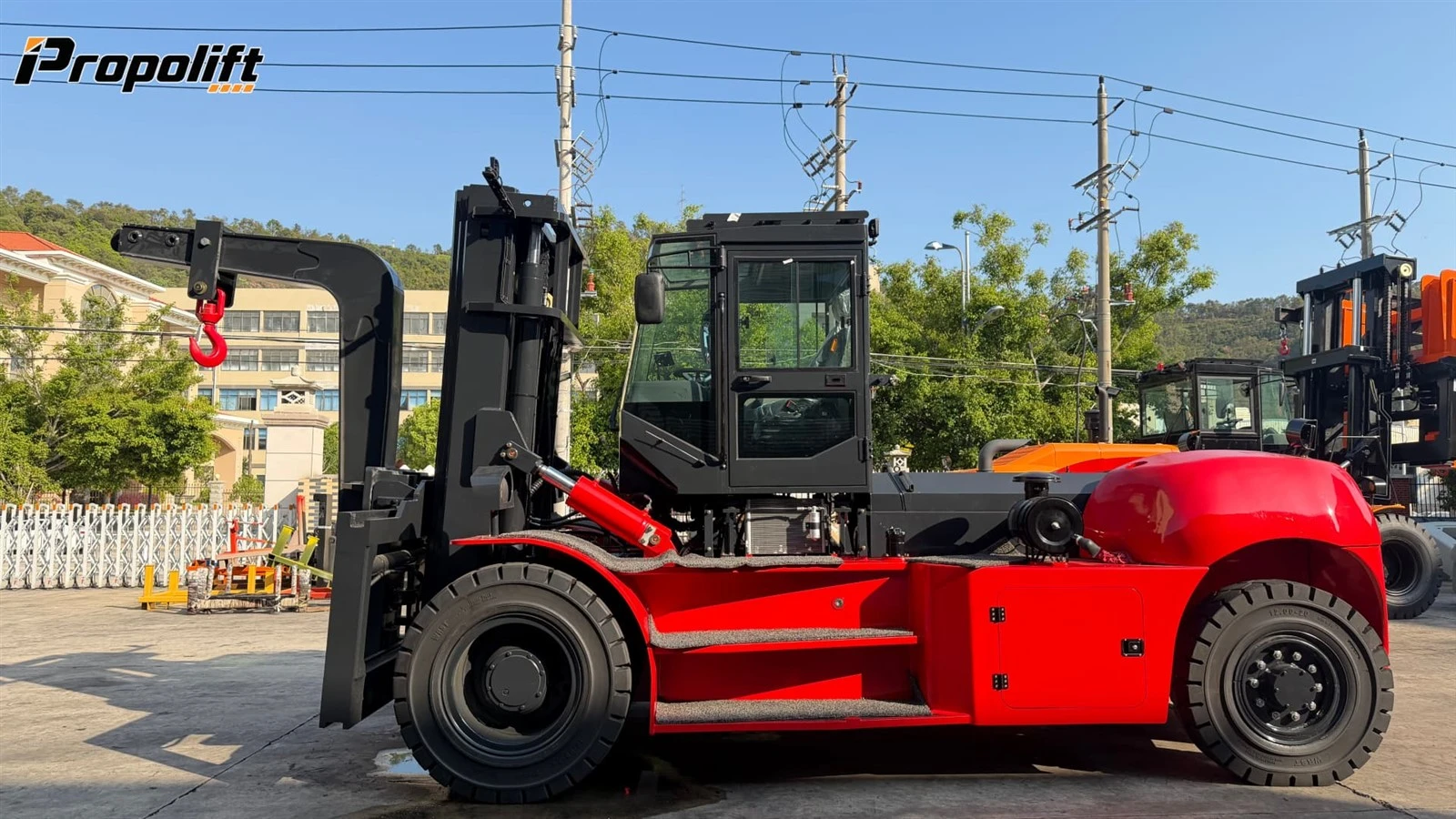
What Does The Boom Do?
A lifting boom extends forward from the forklift carriage and provides a hook or lifting point.
Instead of placing the forks under the cargo, the operator connects the load to the boom using the appropriate lifting arrangement.
This can be useful for:
- machinery
- molds
- industrial components
- project cargo
- equipment without suitable fork pockets
The boom may be fixed or designed with different lifting positions depending on the application.
Boom Length Affects Capacity
One of the most important points is the distance between the forklift and the lifting point.
As the boom extends farther forward, the load center also moves forward.
This means the forklift's usable lifting capacity can decrease.
For this reason, we need more information than just the load weight.
The customer should also provide:
- maximum load
- lifting point position
- required boom length
- lifting height
- load dimensions
These details allow the forklift and attachment to be evaluated as one complete system.
The Attachment Itself Also Has Weight
A heavy-duty boom is not a lightweight accessory.
Its own weight becomes part of the front load on the forklift.
When configuring a machine, this needs to be considered together with the cargo weight and load center.
Ignoring the attachment weight can lead to an incorrect capacity calculation.
Built Around The Actual Job
Lifting booms are a good example of why special forklifts should not be selected only by nominal tonnage.
A customer may say, "My load is 15 tons," but a 15 ton load suspended far in front of the mast creates a very different condition from a compact 15 ton block sitting close to the forks.
At Propolift, we normally ask for a drawing, photograph or basic lifting dimensions before confirming this type of attachment.
For irregular industrial loads, understanding where the load will actually hang is one of the most important parts of the configuration process.