


How To Choose The Right Fork Length For A Heavy Duty Forklift
Fork length may look like a simple specification, but on a heavy duty forklift it can directly affect how the load is supported and where its center of gravity sits.
For standard pallet handling, fork selection is usually straightforward. For machinery, steel products, molds and project cargo, the situation can be very different.
That is why we normally ask for the load dimensions before confirming fork length.
Forks Should Support The Load Properly
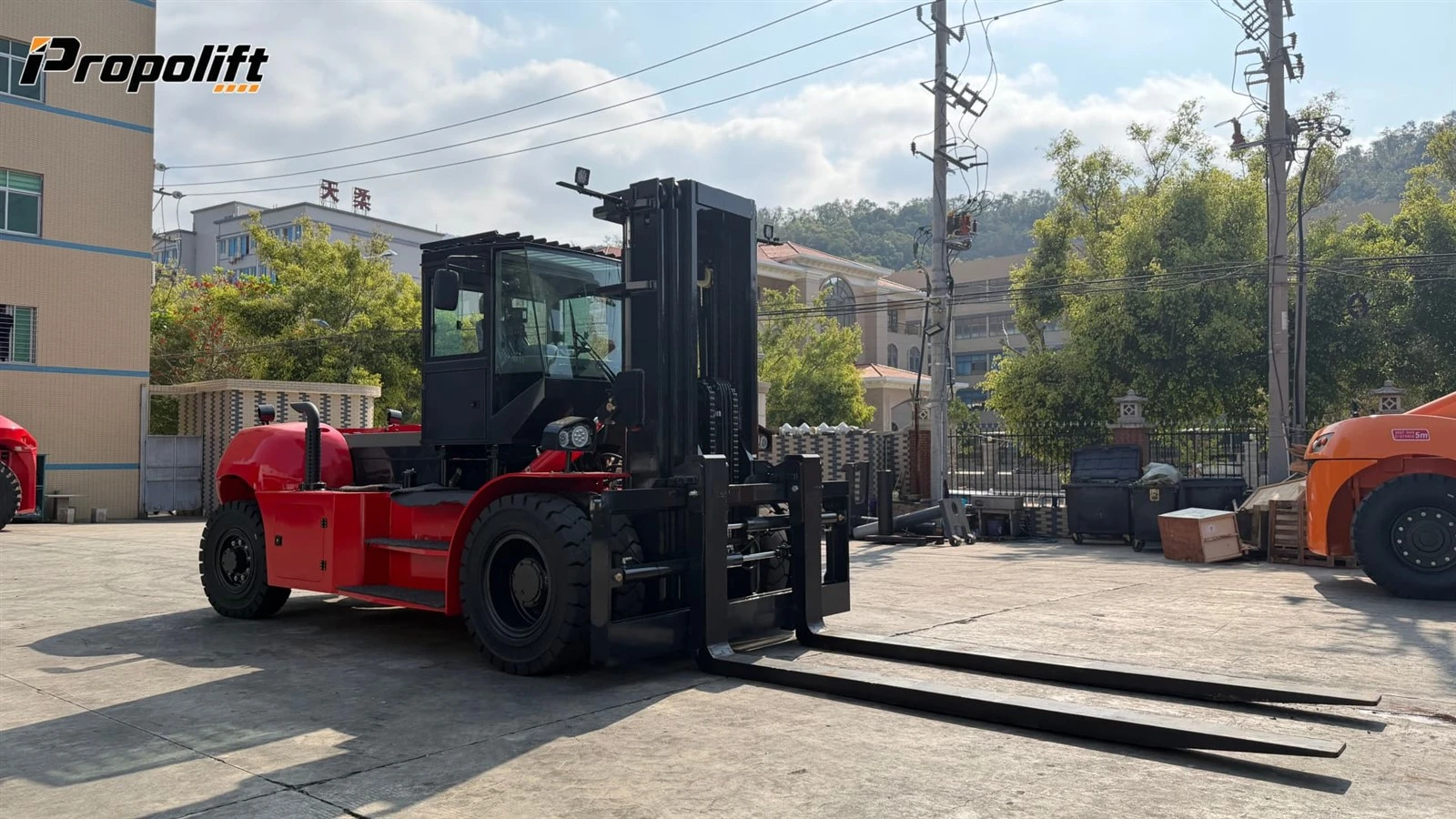
The forks need enough length to provide stable support under the material.
If they are too short, the load may not sit securely. If they are unnecessarily long, they may make positioning more difficult and can allow the load to sit farther forward.
Typical heavy-duty loads include:
- machinery
- steel blocks
- molds
- large crates
- construction components
- industrial equipment
Each may require a different fork arrangement.
Longer Forks Can Change The Load Center
A longer fork does not automatically reduce forklift capacity.
What matters is where the load is actually positioned.
If a long load places its center of gravity farther from the fork carriage, the effective load center increases. This may reduce the available lifting capacity.
That is why fork length and load dimensions should always be evaluated together.
Fork Section Also Matters
For heavy duty forklifts, we also need to consider the fork cross section.
As capacity increases, forks become thicker and wider to support higher loads.
The fork design therefore needs to match:
- forklift capacity
- load weight
- load distribution
- load center
- application
For some projects, standard forks are not the best solution at all, and a special attachment may be more suitable.
Provide The Load Dimensions
Before confirming fork length, useful information includes:
- load length
- load width
- load weight
- fork entry direction
- load center
- required lifting height
A simple drawing or photograph often helps.
At Propolift, we prefer to select fork length around the actual material instead of simply using the longest available option.
The correct fork should provide enough support without creating unnecessary length in front of the forklift.