


How to Choose a Forklift for Long and Oversized Loads
Oversized cargo is one of the applications where forklift tonnage can be misleading.
A customer may tell us:
"The load only weighs 10 tons."
But if that load is 5 meters long, the forklift problem is very different from handling a compact 10-ton block.
Long loads affect:
- Load center
- Fork length
- Fork spacing
- Carriage width
- Turning space
- Visibility
This is why oversized-load projects should be selected around the cargo dimensions, not just the weight.
Start With the Fork Entry Direction
The same load can create very different forklift requirements depending on which side the forks enter from.
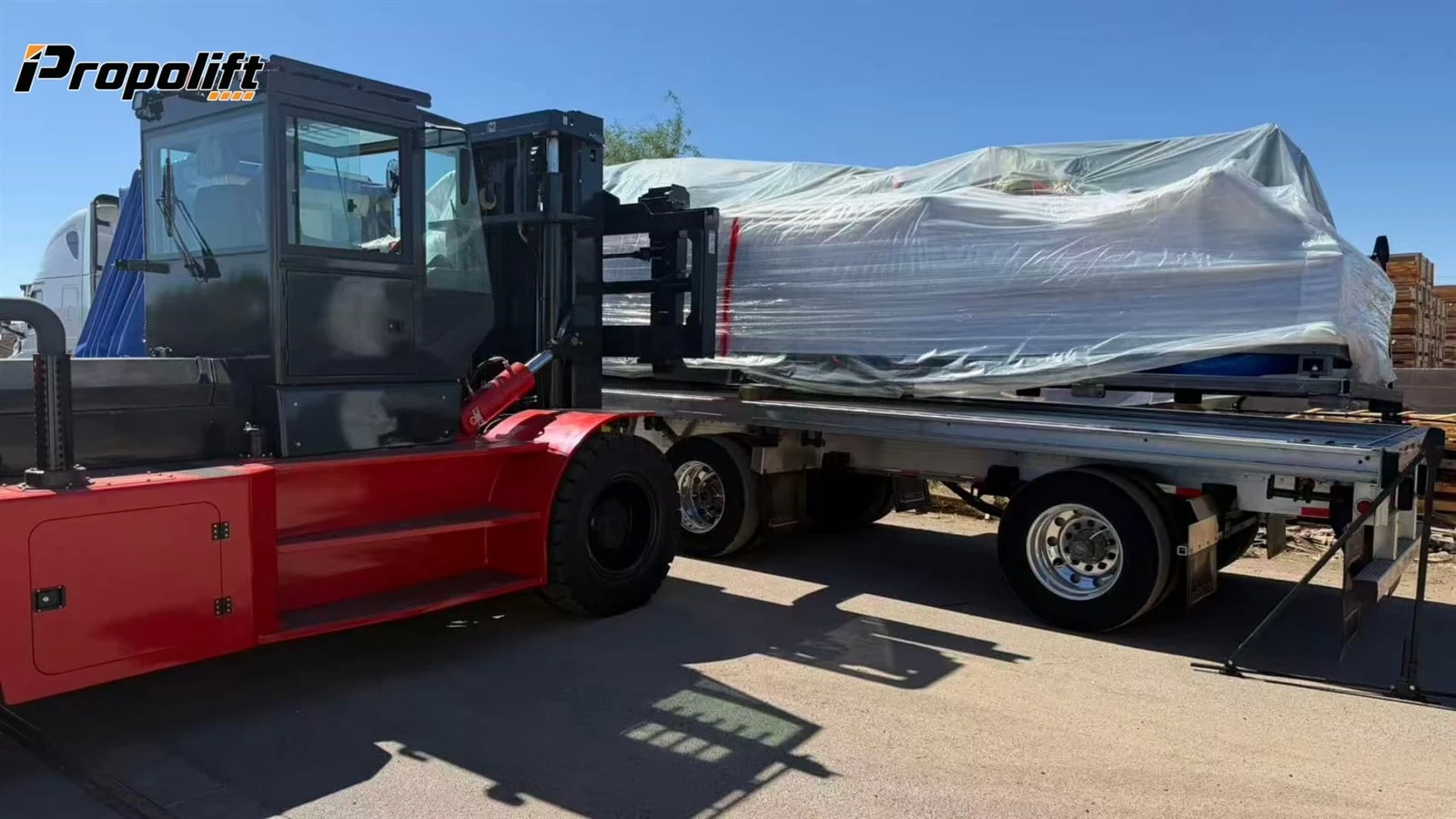
Suppose a steel component measures 5,000 mm × 1,500 mm and weighs 20 tons.
If the forklift approaches from the 1,500 mm side, the forks extend along the 5,000 mm dimension. For an evenly distributed load, the approximate load center may reach 2,500 mm, which can significantly reduce the forklift's available lifting capacity.
If the forklift approaches from the 5,000 mm side, the forks extend along the 1,500 mm dimension, giving an approximate load center of 750 mm. This is much more favorable for lifting capacity, although the truck still needs to be checked at the required 4-meter lift height.
This is why we always confirm the fork entry direction when selecting a forklift for long or oversized load
Long Loads Often Mean Larger Load Centers
For an evenly distributed load, the center of gravity is roughly around the middle of the load.
A 1,200 mm load may have an approximate 600 mm load center.
A 2,400 mm load may have an approximate 1,200 mm load center.
This means a long load can create a much larger load moment even though the weight has not changed.
A forklift rated for 16 tons at 600 mm should not automatically be assumed to lift 16 tons at a much longer load center.
Longer Forks Help Support the Load - But Do Not Create Capacity
Long loads may require:
- 1,800 mm forks
- 2,400 mm forks
- Longer customized forks
depending on the application.
Longer forks help reach and support the cargo.
They do not automatically increase the forklift's capacity at the new load position.
This is why we always consider fork length and load center separately.
Fork Spacing Matters
Wide cargo often needs wider fork spacing.
If the forks are too close together, the load may be poorly supported and less stable.
On our 10–52 ton heavy duty forklifts, hydraulic fork positioning is normally part of the standard configuration, allowing operators to adjust fork spacing according to different loads.
For extremely wide cargo, however, the carriage width and maximum fork spread still need to be checked.
A wider carriage or another customized arrangement may be required.
The Center of Gravity May Not Be in the Middle
Oversized machinery is often unevenly balanced.
A 4-meter-long machine may contain:
- A heavy motor at one end
- A gearbox on one side
- A hydraulic unit at the rear
Its actual center of gravity may therefore be far from the geometric center.
For this type of load, drawings are much better than simple overall dimensions.
If the equipment manufacturer can provide the center-of-gravity location, include it in the forklift inquiry.
Turning Space Can Become the Real Problem
Sometimes the forklift has enough capacity to lift the load but not enough room to move it.
Long cargo can swing through a very large area during a turn.
Before selecting the truck, consider:
- Aisle width
- Yard width
- Door openings
- Storage layout
- Turning area
This is especially important when moving steel sections, pipes, timber, machinery or project cargo.
A forklift that can physically lift the load may still be impractical if the operating area is too narrow.
Side Clearance Matters Too
Oversized loads may extend beyond the sides of the truck.
This affects:
- Visibility
- Travel route
- Pedestrian separation
- Doorway width
- Nearby equipment
For very long products, route planning becomes part of the handling solution.
Sometimes the best answer is not a larger forklift but a different way of approaching the load.
What About Jibs or Lifting Beams?
Some oversized loads cannot be supported properly from underneath.
In those cases, a jib or customized lifting device may be considered.
But suspending the load from a hook changes the load position and working geometry.
The horizontal reach of the hook becomes important.
A nominal forklift capacity cannot simply be applied to a hook positioned far in front of the carriage.
What Information Should Be Provided?
For long or oversized cargo, send:
Maximum weight
Overall dimensions
Fork entry direction
Center of gravity, if known
Fork pocket dimensions
Required fork spacing
Required lifting height
Photos of the working area
For long loads, a plan view of the operating area can also be useful.
Final Thoughts
Long loads create a different forklift problem from compact heavy loads.
The forklift needs enough capacity, but it also needs the correct:
load center, fork length, fork spacing and operating space.
From a factory perspective, the safest way to select the machine is to start with a drawing of the load and then look at how it will actually move through the site.
References
1. OSHA - Powered Industrial Trucks: Narrow Aisles and Safe Load Handling
Notes that long, high and off-center loads can affect forklift capacity and should be handled with appropriate fork spacing and load positioning.
2. OSHA - Stability of Powered Industrial Trucks
Explains how oversized loads and loads with an offset center of gravity affect load moment and allowable capacity.
3. OSHA - Forklift Nameplate and Capacity
Explains that load size, position and weight distribution affect capacity and that irregular loads may require reevaluation.
4. OSHA - Forklift Attachments
Explains how attachments and extended load positions can alter center of gravity and usable capacity.